
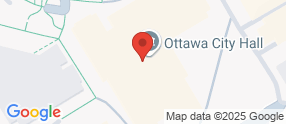
City Hall displays artwork on each and every floor, at entranceways, in stairwells, and outside along pathways and grounds.

The Acrobat's Rocking Horse, Set Free
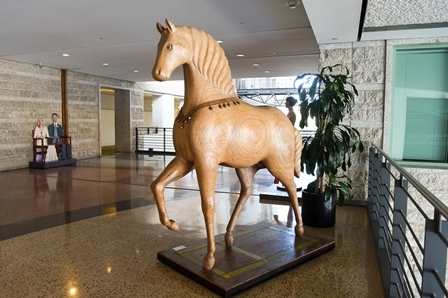
Victor Tolgesy built this sculpture based on the principles of simplicity, balance and proportions. Born in Hungary, Victor Tolgesy moved to Canada in 1951 and began exhibiting in 1958. He left a permanent mark on the visual arts in Ottawa through his contributions as an artist, educator and leader in the artistic community. In 1973, he was elected a member of the Royal Canadian Academy of Arts. Victor Tolgesy's work is included in numerous public and private collections. He completed the City of Ottawa's first public art commission, a papier-mâché sculpture entitled McClintock's Dream, for the ByWard Market Building in 1978.
Fable VII
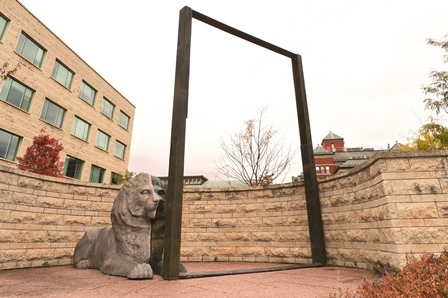
Fable VII consists of 3-components; the interior inscription, a bronze element in the exterior pool, and the lion with an accompanying frame. The artist anticipates the viewer to gravitate towards the interior pool inside the main lobby and find the inscription "Ex Oriente Lux" (Out of the East comes Light) on the glass windows. From this vantage point the exterior pool will come into the viewer's line of vision, followed by the lion and the frame. The work establishes interplay between interior and exterior spaces and creates a dialogue between the architecture of surrounding buildings. While the bronze frame acts as a sundial, the element in the pool animates the area year long, presenting notions of constant renewal through the use of sunlight and directional alignment. As a complement to Fable VII, local Artist Philip Fry created a landscape garden with Hybrid Lowbush Blueberries, local pink Meadowsweet Spirea Tomentosa and granite stones, arranged to suggest the shape of reclining animals. Trevor Gould was born in 1951, Johannesburg, South Africa, and moved to Canada in 1980.
Family Portrait
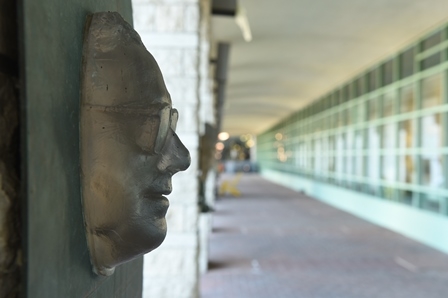
Stephen Brathwaite belongs to the social realism school of art. Though his work is representational, the underlying meanings and inspiration justify viewer contemplation. Creating a welcome feeling of intimacy in the arcade, Family Portrait celebrates the individuals that comprise the 'regional family'. Chosen for their diversity, contributions, and eccentricities, Brathwaite cast the faces of 28 individuals ranging from a spiked-haired student/photographer in Nepean to a farming husband and wife team in Kanata. These individuals reflect the spirit and character of their municipality and together create a time capsule. The municipalities represented here are Cumberland, Gloucester, Goulbourn, Kanata, Nepean, Osgoode, Ottawa, Rideau, Rockcliffe, Vanier and West Carleton. Born in Ottawa, Stephen Brathwaite is a well-respected glass artist who studied his BA at Carleton University, 1971.
The Living Room
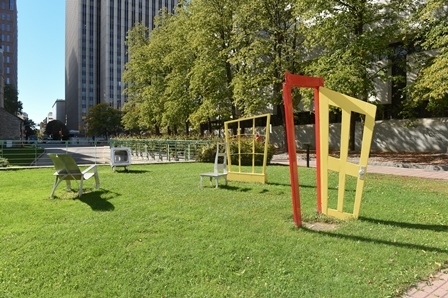
Originally planned as a theatrical stage set with props, this invented room provides a place for personal thinking and public observation. As visitors walk around and through The Living Room, a relationship between the participant's body and each object at the site begins. A doorway, some chairs, a window and a television have been positioned close together to replicate the intimacy of an interior space and to acknowledge the spatial limits of an urban environment. Visitors are encouraged to enter the scene and consider how ideas are formed by the events taking place in the outside world.
In 1991, Nickolas D. Semanyk and Jason Grant-Henley, both of whom studied architecture at Carleton University, formed a partnership and named it URBAN KEIOS.
The Lost Child
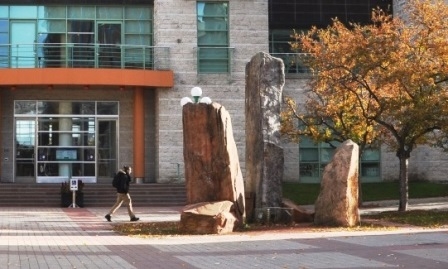
Centuries-old Inuit customs of guiding travellers inspired the artist to create this cairn, a directional marker. The assemblage of stones recalls the artist’s childhood experience of wandering amongst tall city buildings. The leading stone represents a sentinel, its voice shining as it calls out. Symbolizing triumph over the feeling of alienation in the urban environment, this gathering site provides a place of respite and contemplation.
Born near Paulatuk, Northwest Territories, artist David Ruben Piqtoukun grew up in Edmonton, Alberta. At age 22, he began stone carving and re-established his connection to Inuit culture by collecting traditional stories and ways of living from family and community elders.
The largest boulder in this assemblage, which is built with sandstone from Kingston, Ontario, is 5.8 metres tall and weighs 27,000 kilograms.
Nautilus
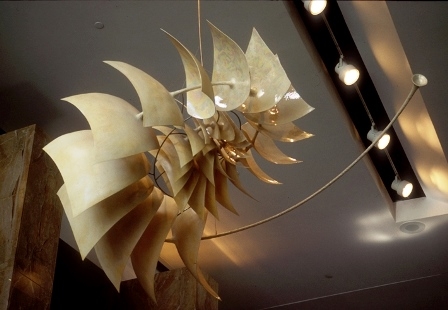
Drawing inspiration from the nautilus shell, Paula Murray created Nautilus to celebrate the rhythmic energy paralleled in nature and society. The mathematically correct architecture of the symbolic spiral structure instils energy, strength, power, and unity into the work. Whether viewed from below on the first floor or at eye level from the second floor, Nautilus reveals an airy sense of movement with a continuous play of light and shadow. The lustrous and delicate appearance of the work is achieved through the use of translucent porcelain arcs, with each arc individually moulded and fired in an electric kiln to 2400 degrees fahrenheit to achieve translucency. Paula Murray is one of Canada's leading contemporary craft artists. Living in Chelsea, Quebec, Murray has been a studio potter for more than twenty years.
On Top of the World
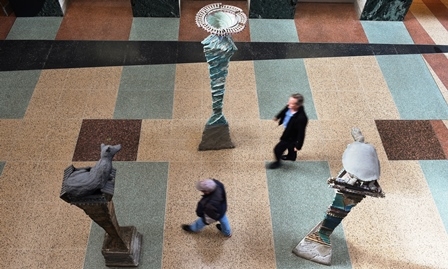
To add a spirit of optimism to the place where people pay their municipal taxes, artist Jim Thomson proposed this statue in the entrance of the Client Service area of City Hall. The statue's reference various mythological traditions and thematically correspond to the two-metre high vases upon which they are placed. The turtle's home on his back represents his history, experience and wisdom, and relates to his perch of archeological fragments. The black dog is the Trickster who tries to trick us into learning. He is governed by the same strict and solid rules as is the vase upon which he stands. The jeweled bowl, perched on a spiral of pure energy, is an icon for the conquest of the spirit. The dog and the turtle both gaze at the bowl, which basks them in the notion that they will forever be positioned on top of the world. Jim Thomson studied art in Thailand, Japan and at the Banff Centre for the Arts.
Outreach
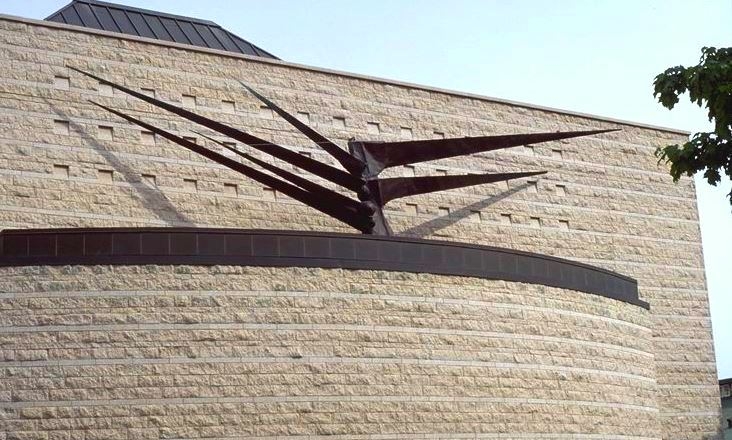
The abstract forms of this 19.5 foot tall sculpture are a symbol of the extended reach given to humanity through our adoption of technology. The large branches of the piece move outward and upward, emulating the growth afforded to humans by the use of technology. As if to caution us not to forget why technology develops, the branches are firmly attached to a central core, representing the strength of relationships between members of the human family.
Having worked primarily in metal and stone, sculptor Bruce Garner built uplifting monuments to action, physicality, and life. Garner taught himself to use much of the heavy machinery required to build outdoor sculptures and developed a distinctive hammer technique for shaping metal. Many of his most popular artworks can be found in Ottawa on Sparks Street, at the Conference Centre, and at the Ottawa General Hospital.
Rivers Reflecting Seasons
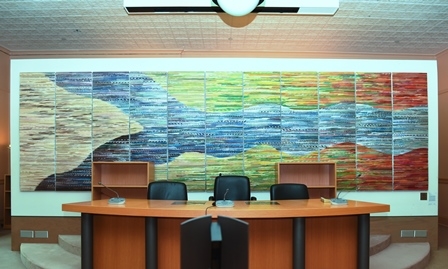
This tapestry, located in the Keefer Room of the Heritage Building, conveys an impression of the Ottawa, Rideau and Gatineau Rivers as portrayed on the Ottawa-Carleton regional flag and heraldic crest. The eleven panels, representing each of the previous municipalities of the region, evoke the movement and energy of the rivers and emulate the patterns of the furrowed fields. The material symbolizes the melding of silver and gold metallic to reflect the environmental elements of water, ice, snow and sun on the landscape through the seasons. Carole Sabiston, born in London, England, has lived in Victoria, British Columbia since 1952. She is a member of the Royal Canadian Academy and 1987 winner of the Saidye Bronfman Award for Canada for Excellence in Art.
Sachi's Isochron
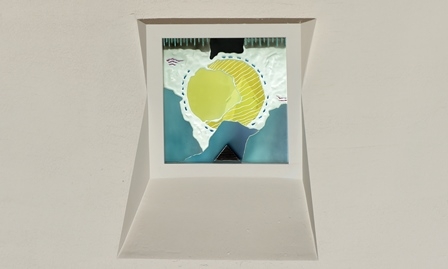
Sachi's Isochron, a permanent window installed high on the southwest rotunda wall, creates a mystical acknowledgement of time and date. The use of Dichroic glass enables the transformation of the daytime image of a yellow sun disk to a blue crescent at night. Also, twice a year at noon, a red triangular area is illuminated for an hour, marking the dates of the autumnal and vernal equinoxes. With the help of an astronomer, Warren Carther achieved this effect by attaching a mechanical device at the rear of the glass panel that aligns itself with the sun on the equinoxes. Carther received a BFA in glass blowing at the California College of Arts and Crafts, 1978. Having produced over 60 projects in his career to date, Warren Carther has installed permanent works in Japan, Hong Kong, France, Canada and the United States.
Structure
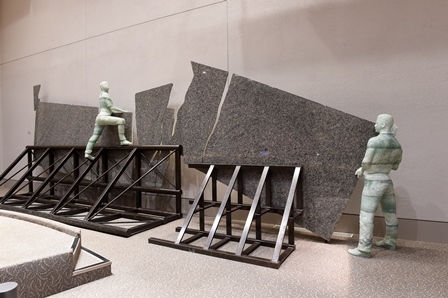
For this particular piece, fragments of polished granite with cut and raw edges are being supported and united by a structure of steel. Located in Council Chambers as a backdrop to all City decisions, the work expresses the need for collaboration. A figure cast in glass appears to be pushing part of the piece into place while another uses the support to climb on. The stone is a symbol of community and is divided into eleven fragments, representing the eleven amalgamated municipalities of Ottawa that vary in size, shape, and character. Though the stones do not fit together as a perfect whole, Structure acknowledges and applauds the effort given to keep the piece unified. Local glass artist, Stephen Brathwaite, has an extensive commission practice and is included in public, private, and corporate collections. He has completed work for the Canadian Consulate in Chicago, the Canadian Pavilions in Spain and Korea, and at Strathcona Park, Ottawa.
Virtual Instrument Paradigm (V.I.P.)
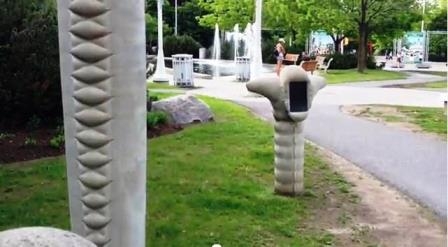
Made up of concrete towers housing speakers and electronic components, V.I.P. is the City of Ottawa's first computer-based artwork. V.I.P. may generate its own music or emit sound compositions activated by movement on the pathway. Developed by composer and innovator of electronic media Michael Bussière, this interactive installation combines sculptural forms designed and constructed by Mark West with surprising musical arrangements. V.I.P. is an experiment in art that explores the potential of computer music and public performance.